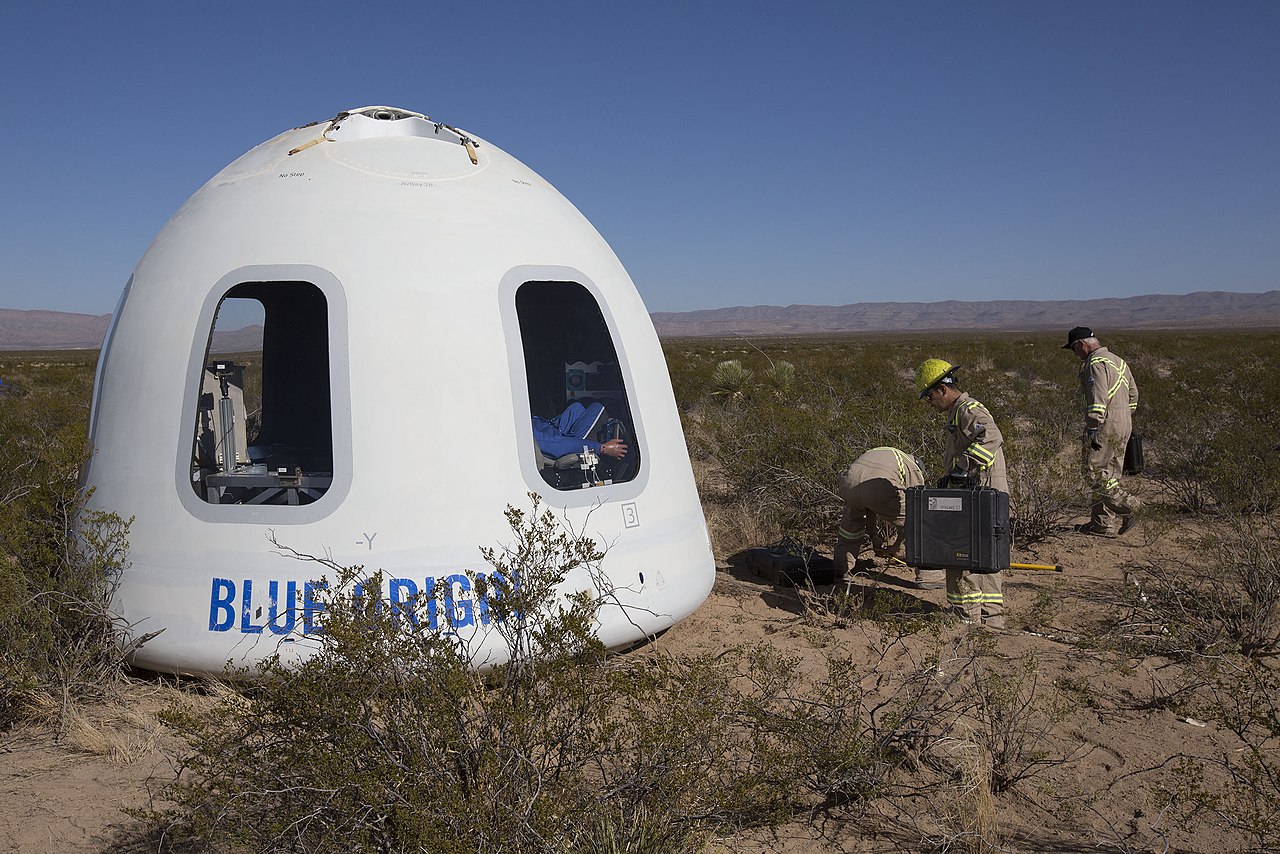
“It’s the oligarchy in space, read the room.” encapsulated the dilemma surrounding the recent satellite launch by Blue Origin, and this comment aptly addresses the issue surrounding the maiden voyage that was both momentous and divisive. It was a momentous event, and for the first time since the Kármán Line was crossed over 60 years ago, six women and they include singer Katy Perry and television talk-show host Gayle King – traveled to space with the help of the Blue Origin company founded by the billionaire philanthropist and businessman Jeff Bezos. The other five are engineer and entrepreneur Aisha Bowe, civil rights advocate Amanda Nguyen, and film producer Kerianne Flynn.

It only took the capsule 11 minutes to reach over 100 kilometers into the sky, giving the group a brief experience of what it feels like to be weightless. Upon landing, Perry planted kisses on the Earth and held out an open daisy toward the sky as if she were paying homage to her daughter, Daisy. King knelt down to “appreciate the ground for just a second,” while Flynn pointed skyward and declared, “I went to space.” Sánchez, visibly moved, said, “I looked out of the window and we got to see the moon. Earth looked so quiet… but really alive.”
It is the first all-female mission since Valentina Tereshkova went alone in 1963. Such a milestone was made possible by the many accomplishments of women in the field of space exploration, such as the first Space Shuttle mission of Sally Ride and the record-breaking 675 days in orbit set by Peggy Whitson, but this specific venture, like the previous one, raises again the question of whether celebrity-funded space missions facilitate or diminish the notion of space exploration.
Dr. Kai-Uwe Schrogl, from the European Space Agency, said: “A celebrity isn’t an envoy of humankind they go into space for their own reasons… Celebrities do it for amusement but get a lot more attention than the regular astronauts.” Olivia Munn, one of the critics, was worried about the implications for spending so much money on the ‘joy ride’ when there is “there’s a lot of people who can’t even afford eggs.” Others, including Dr Tanya Harrison of the Outer Space Institute, acknowledged the marketing aspect but conceded that the all-women crew “might change the demographics a little bit of who might want to do something like this.”
Supporters said this is a way of encouraging a whole new generation of followers. King described the reception of this flight as “a huge, positive response from young women and young girls.” Sánchez invited the criticism of these sorts of expeditions and encouraged the critics of Blue Origin to view the “thousands of employees who put their heart and soul into” into these expeditions. Aside from cultural perceptions, there are also pressing environmental concerns that fall under quasi-political matters.
For instance, Blue Origin prides itself on how New Shepard emits only water vapor during combustion; however, Eloise Marais, an environmental chemist, argues that while water vapor may have a higher concentration of water vapor that eventually enters the upper atmosphere, it is another form of a greenhouse gas. This can result in a change of stratospheric composition, lower ozone concentrations, more ozone holes, and cloud formation that affect climate change patterns. Data shows that rocket launch engines have been emitting gases and aerosol particles, aluminas, and black carbon at a direct outflow into the stratosphere for a longer period and a more pronounced effect than rocket engines emitting lower concentrations of gases. Predictions on rocket emissions revealed that black carbon and chlorine emissions could prolong ozone recovery times, which has not yet happened since the Montreal Protocol after several decades of implementation.
The total space tourism industry, which would belong to the embryonic stage, has been forecast to grow in line with the total space economy, which could reach $1.8 trillion by the year 2035. However, already there are developments that aim to democratize this industry, where the costs could go down through government cooperation and sponsorship for education. But for now, for just $150,000, a deposit would already include a ticket to go to space for a suborbital flight to Blue Origin.
For the socially engaged viewer, the mission in this series could best be summarized in terms of the theme of space travel in its inclusivity, which was the leap for women in terms of representation in space against the themes of privilege, space, and in particular, the role of show vs. science. As already evidenced in the passage of history, moments in space can lead to transformations in significant ways but whether this moment would be seen in time in retrospect to lead to inclusivity or just something new and pretty in the distance would soon be seen.