
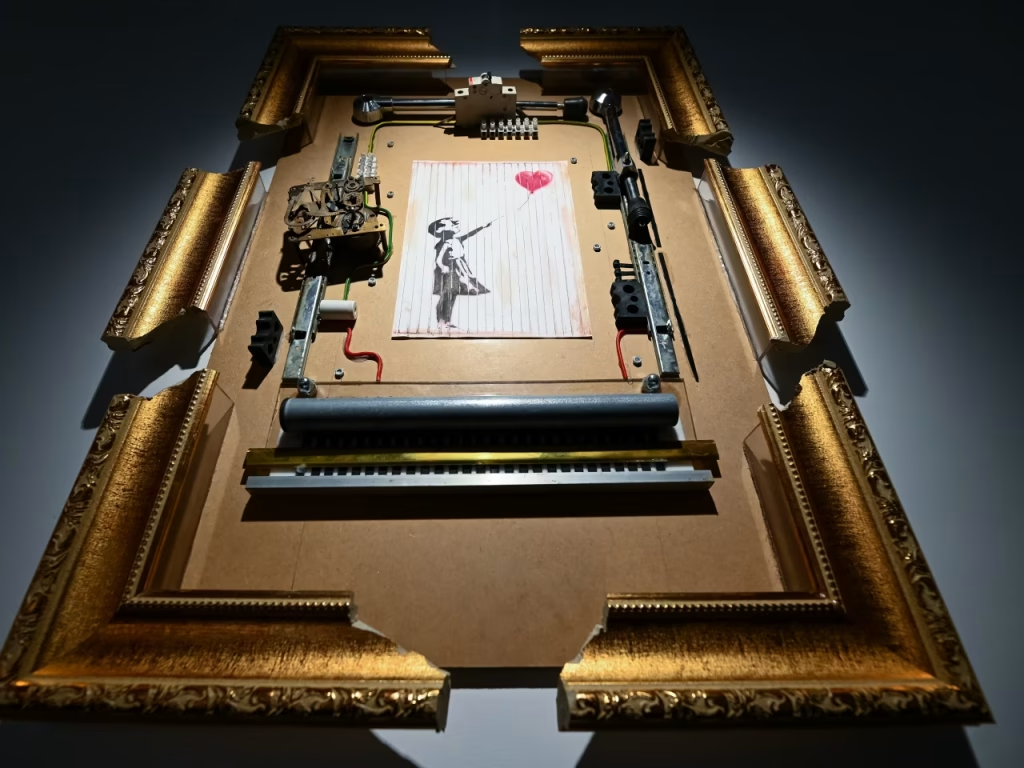
Banksy’s greatest performance may have been anonymity, and the market built around it is now entering a new phase. For years, collectors bought the work while also buying into the riddle. That tension helped turn stencil art into a global spectacle: the prankster who slipped pieces onto museum walls, the artist who transformed a Sotheby’s sale into theater when “Girl with Balloon” partially shredded itself in 2018, and the cultural dissenter who could still appear overnight on a building and vanish by morning. Now that Reuters has tied Banksy to Robin Gunningham through a handwritten New York court confession, a different kind of value is coming into view.
In the art trade, mystery can attract attention, but identity still matters. The market tends to reward artists whose biography, authorship and paper trail feel settled, especially once prices move into the millions. That helps explain why some insiders see the unmasking not as a threat to Banksy’s legacy, but as a form of stabilization. One dealer in the main report described the old problem bluntly: buying an unknown figure could feel like buying folklore.
Banksy’s market has already shown how strongly narrative affects price. The shredded work, later retitled “Love is in the Bin,” sold for $25.4 million in 2021. Auction activity surged in 2021 and 2022, then cooled. Even within one signature image, values have moved sharply: versions of “Girl with Balloon” reportedly changed hands for as much as $4 million several years ago, then drifted down before recovering toward the seven-figure range. The point is not simply that Banksy is expensive. It is that Banksy has become one of the clearest examples of how authorship, performance and market confidence feed one another.
There is also a practical layer beneath the mythology. Because Banksy’s work has long been vulnerable to forgery, his market relies heavily on Pest Control, the sole official authentication body. That system gave buyers a route to certainty even when the artist himself stayed hidden. In that sense, anonymity never meant absence. It meant distance, carefully managed through intermediaries, certificates and a brand structure strong enough to support nearly 9,000 auction trades, according to the main article. But anonymity did more than protect the artist from scrutiny. It protected the method.
Banksy’s former associates and legal observers have long noted that concealment served an obvious purpose in a career built partly on illegal public interventions. The reference material shows how deeply that instinct shaped the work, from Bristol beginnings to a legal battle in which “Robin Gunningham” was named as a defendant and the question of identity became part of the case itself. The tension between public fame and private invisibility was never side material; it sat at the center of the enterprise. As Banksy once put it, “invisibility is a superpower.”
That is why the next chapter matters. Reuters also reported that Gunningham later used the name David Jones, a detail that adds another twist without restoring the old mystery. What it cannot restore is the original condition under which Banksy became Banksy: the sense that the artist could be anyone, anywhere, and untouchable. If fresh work keeps appearing with the same force, collectors may treat the unmasking as a footnote and earlier pieces as even more important relics from the fully anonymous era. If the interventions slow, the older works may become the purest record of a persona that can no longer exist in quite the same way. Either way, the market now has what it usually wants most: a name, a trail and a story that still feels larger than the facts.


